The object of this tour is to present different episodes of Andorra’s history.
The tour starts in front of Saint John’s church, continues through la Closa’s path and ends in front of Casa Rull’s museum.
Sispony is a town situated in the parish of La Massana, located at 1.360 meters, it has a Quart (collaboration agreement between the local council and the Quart of La Massana) and more or less a thousand inhabitants.
Sispony holds coexistent testimonies of the old Andorran way of life which was based on an almost subsistence agricultural and livestock economy. The modern architecture of a pseudo-traditional aesthetic, doesn’t change the fact that they are still constructions of a dormitory town almost without life or soul which have devoured the meadows.
The tours, only for special groups, can be booked writing an e-mail at reservesmuseus@govern.ad.
Elements of the itinerary
Introduction
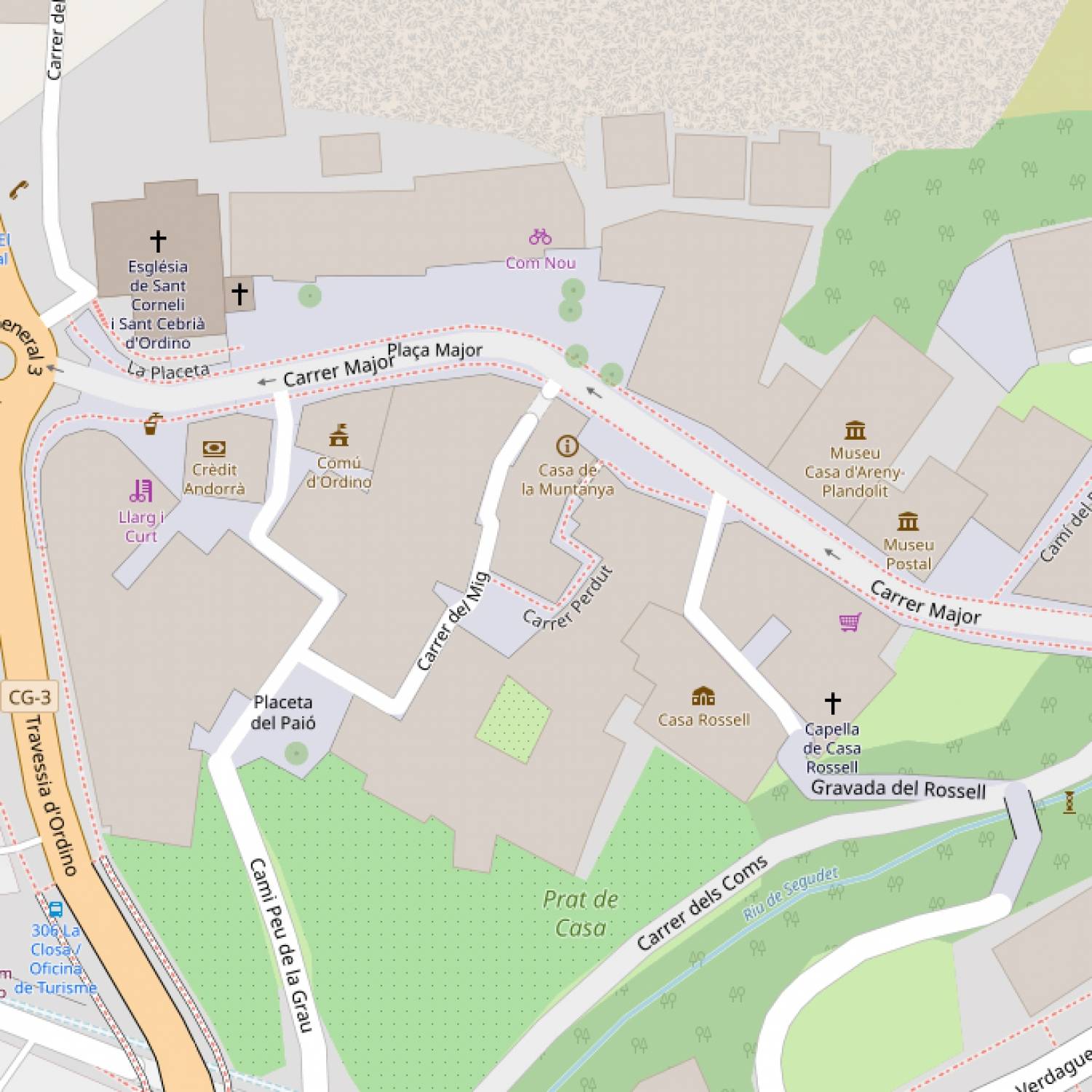
Church of Sant Corneli i Sant Cebrià
Private Family Chapels: Casa Rossell
Private Family Chapels: Museu Casa d’Areny-Plandolit
The Areny family were wealthy farmers who owned vast tracts of land and numerous livestock.
The Areny family’s marital alliances led them to acquire a title of nobility and transform their ancestral home in Ordino into a true noble house, complete with a chapel and a library.
The private chapel reflects the family’s deep religious devotion. Dedicated to Our Lady of Sorrows, it also houses another depiction of the Virgin Mary, Our Lady of Mount Carmel, represented in a high-quality Baroque painting from the 18th century by an anonymous artist.
In the painting, we see two kneeling Franciscan friars, a landscape that adds depth to the work, and the Virgin of Mount Carmel with the infant Jesus on her lap.
In the hallway leading to the chapel, above the doorframe, there is a portrait of Saint Ermengol, wearing a rich pluvial cape and holding the episcopal staff, dated to the mid-17th century and attributed to the painter Jeroni d’Herèdia, the master of Ansalonga.
The master of Ansalonga was a skilled painter, capable of creating faces with great expressiveness and solemn, lifelike characters.
Some houses belonging to wealthy families had private chapels. To build a chapel, in addition to the necessary resources, permission from the Church was required. These buildings were consecrated as authentic embassies of heaven on Earth and, as such, had to be integrated under ecclesiastical authority.
In Ordino, the first private chapel to be built was that of Casa Rossell. In 1779, the Bishop of Urgell granted permission to construct the temple, and a year later, he consecrated it.
This small, single-nave chapel is dedicated to Our Lady of the Immaculate Conception. It has a rectangular floor plan oriented to the northeast, with a small sacristy attached. Additionally, it features a choir from which a passage connects the house to the chapel.
Inside, there is an image of the Immaculate Conception. It is considered one of the most outstanding artistic pieces of Andorran Baroque and was made by an anonymous artist around the mid-18th century.
Although it may remind us of a Romanesque building, the first documented reference to the current church dates back to 1575. In the 18th century, the number of chapels was modified, and in the 19th century, part of the bell tower and the nave were rebuilt.
We are, therefore, faced with a building of Romanesque inertia, but inside the temple, we find iron railings, liturgical furniture, and chapels with Baroque-style altarpieces.
In the Church of Sant Corneli i Sant Cebrià, we preserve five Baroque altarpieces that decorate the apse and the side chapels. They are made of polychrome wood and, for the most part, are small in size, by unidentified authors.
As can be appreciated by observing the altarpieces, the Baroque reinforced the use of images, and the programs were predetermined, established, and standardized, making the themes very common throughout Andorra and Catalonia. They depict scenes and characters such as the martyrdom and passion of Christ, God the Father, the archangels Michael and Gabriel, classic saints (Peter, Paul), but also new saints, promoted after the Council of Trent. Far from the dangers of idolatry, they were useful for preaching and liturgy.
The European context of the Counter-Reformation is key to understanding Baroque art.
The Counter-Reformation was the papacy’s response to Martin Luther’s Protestant Reformation, primarily formalized during the Council of Trent: clergy, theologians, bishops, and archbishops gathered to define Catholic doctrine, reinforce the Pope’s authority, and condemn Protestant reformers. In art, the Catholic Counter-Reformation led to a reinforcement of the use of images—questioned by Protestants—and the creation of increasingly exuberant, ornate, richly adorned, and gilded works.
In Andorra, as elsewhere, religious devotion and practices were shaped by the guidelines set by the Church. However, in Andorra, the Baroque style developed from the mid-17th century, a century later than in other regions, during a period of economic and demographic growth.
Here, we will not find grand buildings; instead, the style was embraced through altarpieces, iron railings, liturgical objects... of modest quality, adapted to the rural context of the country, where repetition took precedence over creativity.